


Cruise lines want faster internet, and scientists want accurate hurricane data. At the center of a 6 GHz debate is a frequency that both sides claim they can’t live without.
Remember the days when “cruise ship internet” was just a nice way of saying you’d spend $30 a day to watch a loading circle and relive the glory days of dial-up?
Those days are officially over.
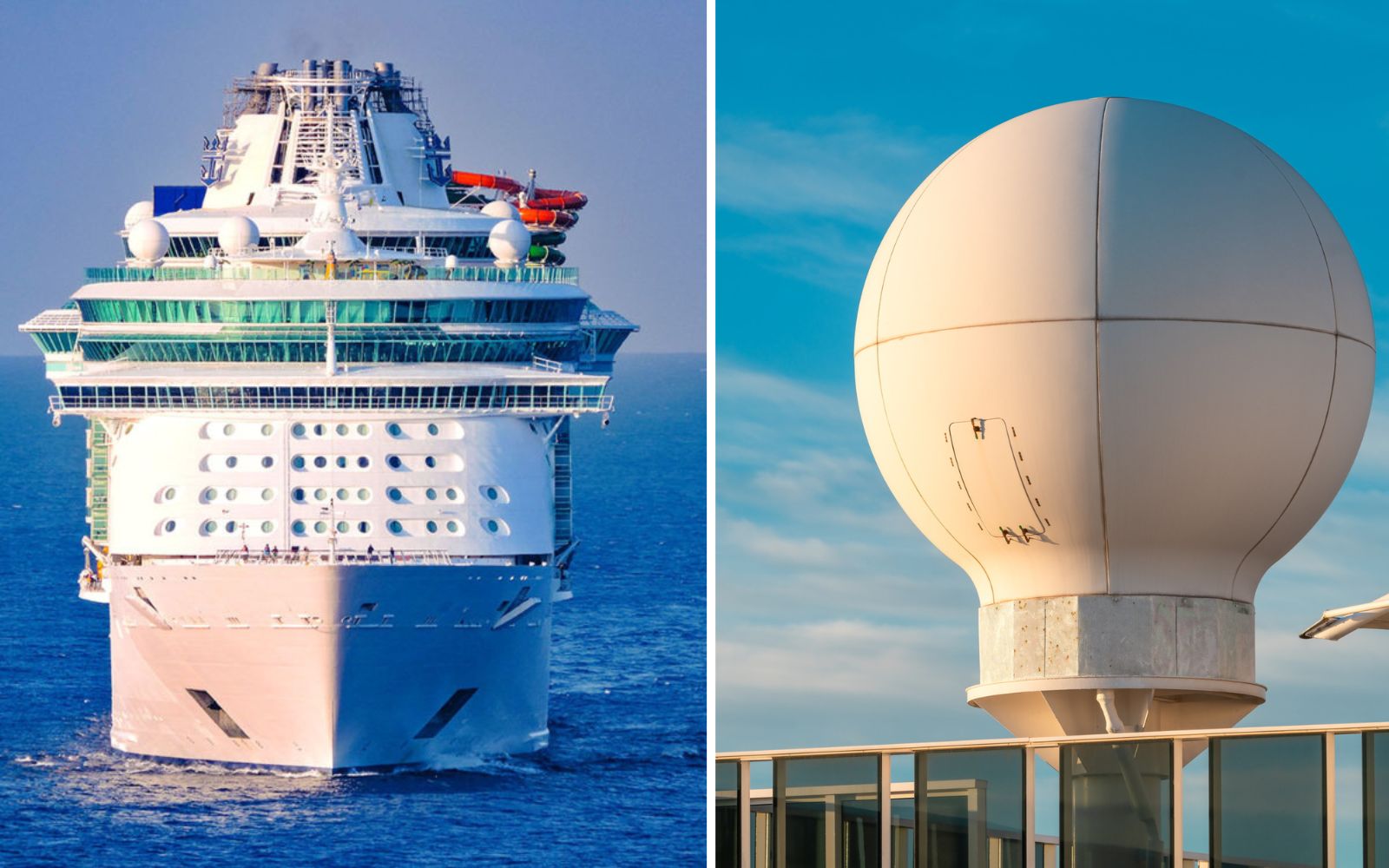
With Starlink now active across almost every major line from Royal Caribbean to Carnival Cruise Line we’ve entered a new era of connectivity. You can now sit on your balcony in the middle of the Caribbean and FaceTime Aunt Suzie to check on the dog back home without a single stutter.
But the cruise industry has concerns that we have reached the limitations of the 2.4 GHz and 5 GHz bands and the bottleneck for today’s high speed needs has to be dealt with before it becomes a bigger problem.
But Starlink…
But doesn’t Starlink solve all of this? Not exactly. You see, even though Starlink makes the internet more accessible and faster, a Wi-Fi router still has to broadcast that signal to your phone or device.
Think of Starlink as a huge, high-speed pipe bringing water to the ship. The Wi-Fi bands are the smaller faucets in your cabin.
Right now, those faucets are clogging. With thousands of passengers trying to stream 4K video and upload TikToks simultaneously (and to all the other social platforms), the traditional 2.4 GHz and 5 GHz airwaves are simply too crowded to keep up.
To fix this, the industry wants to move into the 6 GHz band, the home of Wi-Fi 6E and Wi-Fi 7.
Why Some Don’t Want 6 GHz on Cruise Ships
But not everyone in the scientific community is happy about this.
The claim is that 6 GHz Wi-Fi would create “hot spots” that would not allow them to see the data they need in regards to ocean temperatures and studying hurricane activity.
Scientists use that exact 6 GHz frequency to “listen” to the ocean. Satellites pick up faint microwave signals naturally emitted by the sea surface to measure Sea Surface Temperature (SST).
Because this frequency can “see” through thick clouds, it is the main way we track a hurricane’s strength before it hits land.
Scientists fear that thousands of ships broadcasting Wi-Fi at 6 GHz will create “digital noise,” blinding these satellites and making storm forecasts less accurate.
The “Steel Box” Defense
In the FCC 6 GHz Maritime Proposal (2026), the cruise industry argument, led by Cisco and CLIA, offered a solution and an argument as to why the new Wi-Fi should not be a problem.
This isn’t light reading, but if you go to the PDF and search for “CLIA” in the document you can find the relevant info I’m referring to here.
The cruise industry’s argument is that because modern ships are made of thick steel, they act as a Faraday cage, more or less containing the signal.
In the document the FCC acknowledges the industry claim that these “thick metal walls” should trap Wi-Fi signals inside, preventing them from leaking out and interfering with satellites.

The $35 Million Benefit
The FCC is currently in the middle of this whole thing. In the same 2026 document, they estimate that opening these airwaves could provide $35.6 million in annual benefits.
How did they arrived at that exact number? I had to try to figure it out myself but it’s basically the FCC’s way of doing a time-to-value calculation.
Since 19 million passengers spend an average of 7.1 days at sea, the FCC determined that cruising accounts for 0.11% of all American man-hours in a year. By applying that 0.11% slice to the national $32.4 billion Wi-Fi pie, they hit $35.6 million.
But don’t @ me. I’m no mathematician.
Geofencing Compromise
To try to satisfy the scientists, they are proposing geofencing. This would require a ship’s Wi-Fi to automatically “dim” its power or switch frequencies the moment it enters a sensitive scientific zone or a region where a major storm is brewing.
How this would impact cruise passengers trying to upload that ever-important YouTube video is another matter, but that’s the compromise in question.
Bottom Line
Personally, I sometimes miss the days of being on a cruise and knowing it was a complete disconnect from the “real world”. After all, if your boss can still call or email you, knowing you have internet access, are you really on vacation?
The reality is that more and more cruisers want to stay connected at sea. While a healthy balance of internet use and “ocean time” are important, the need for speed isn’t going away.
For now, the future of your 4K vacation streaming remains tied to the very satellites that keep us safe from the world’s biggest storms.
Looking for the Best Cruise Deals?
Search Multiple Sites at Once
Instant Real Time Pricing
Search Now